
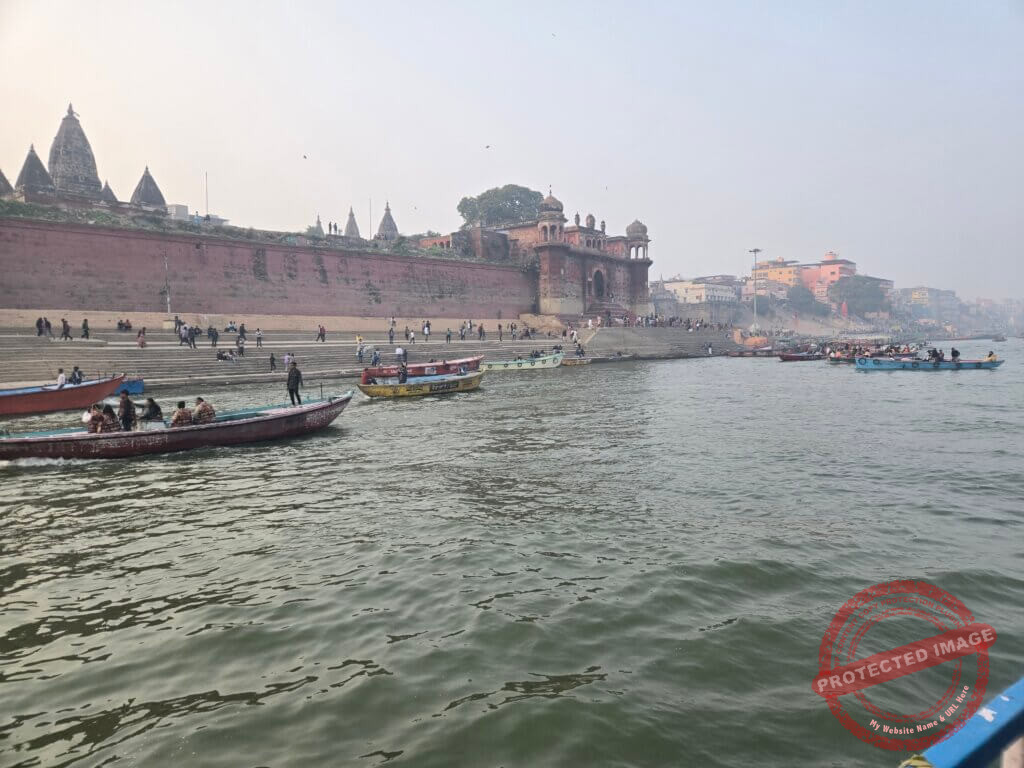
Varanasi is not a city you “see.”
You walk, sweat, get lost, and somewhere between narrow gullies and temple bells—you feel something shift.
We went to Varanasi fully prepared to walk a lot (and I mean a lot). My plan was simple: finish temple visits early, take it slow, and soak in Kashi properly. What I didn’t expect was how different each temple felt.
We visited most of the temples through Google Map Walk option. Before starting the walk we always expanded to check if there is an alternate way from the main roads
1. Kal Bhairav Temple
This is traditionally the first temple one visits in Kashi—and it makes sense. It is one of the most sacred shrines dedicated to Lord Bhairava, the fierce guardian form of Shiva. We reached the temple by hiring an electric rickshaw.
Kal Bhairav is believed to be the guardian of the city. The energy here felt intense but protective, like being firmly told, “You’re safe. Behave, and move forward.” The temple was crowded, but the darshan itself was quick and direct. We didn’t get involved in any extra rituals and simply focused on the moment.
A strong start to the journey.
2. Mrityunjay Mahadev Temple
This temple felt calm, grounded, and surprisingly peaceful. The temple is walking distance from the Kal Bhairav Temple.
Dedicated to Lord Shiva as the conqueror of death, it’s known for healing and protection. There’s a sacred well inside the temple, which is believed to possess healing and protective powers. The overall atmosphere made me want to slow down and breathe. Not chaotic, not rushed—just steady and reassuring.
One of those places where you naturally sit quietly for a while.
3. Sakshi Vinayak Temple
This temple honours God Ganesha as the witness of your visit to Kashi.
The belief here is simple and beautiful: Lord Ganesha quietly observes and records every pilgrim’s journey, prayers, and intentions in the sacred city. While many stories around this temple blend into the larger legends of Kashi, the heart of it all is Ganesha’s role as an impartial observer.
It’s not a grand or crowded stop, but it feels important in a symbolic way. A small temple, but definitely a must-stop during a Kashi visit.
4. Dhundiraj (Dhundhi Vinayak) Temple
The story in Kashi (Varanasi) involves Lord Ganesha appearing as a guide to pilgrims, preventing them from getting lost in the divine labyrinth of the holy city, hence the name ‘Dhundiraj’ (King of Confusion/Search). Legend says Lord Shiva invited Ganesha to manage the city’s overwhelming spiritual energy, and Ganesha, appearing as Dhundi, would subtly direct devotees, removing obstacles and ensuring they find Lord Vishwanath, making worship of Dhundi essential for a complete Kashi pilgrimage.
It is near the line for gate 1 of Kashi Vishwanath temple. So, there will be people standing in the line near the temple.
5. Shri Kashi Vishwanath Temple
This is the heart of Kashi.
The darshan itself is brief, intense, and deeply moving. You don’t get much time for the darshan. So put all your concentration on it before the darshan.
The process can feel overwhelming, but once you’re inside, everything fades except that one moment.
Sparsh Darshan (the opportunity to physically touch the Shivling) is not guaranteed, even during the commonly mentioned time slots of 4:00–5:00 am and 4:00–5:00 pm. On days with heavy crowd, the temple authorities may cancel Sparsh Darshan altogether for safety and crowd management reasons.
To get a faster dharshan, we need to book the Sugam darshan tickets. we can book online through https://www.shrikashivishwanath.org/
The other way is
- Reach Shri Kashi Vishwanath temple Trust Help Centre between 4 am to 5 pm (earliest for smaller queue)
- Buy the Sugam Darshan tickets- there are no slots, just tickets and entry at any time (according to the person behind the desk)
- Don’t forget to buy Rudrakshas to sparsh Shri Kashi Vishwanath swamy. The poojari will touch the Rudrakshas to the god and give them back to you at the time of darshan
- Deposit your stuff in the lockers available (they said bag packs not allowed in lockers, but they allowed us as our bag pack was very small after request)
- Don’t forget to leave your smart watches behind. Even hand sanitizer was not allowed inside
- Phones and shoes, you can deposit inside where there are separate counters inside
- Go through the gate no. 4 with your tickets
- After going through the first security, deposit your phones and shoes and take token
- Then after second security, you will get this amazing darshan.
- Be mindful and alert, the darshan is allowed only for a few seconds.
6. Annapurna Devi Temple
Goddess Annapurna is the form of Parvati who nourishes and feeds the entire universe. The idea itself is simple yet deeply comforting—spirituality here is tied to sustenance, care, and everyday life.
The temple has a calm and grounding presence. One important thing to note: bagpacks are not allowed inside. If you’re visiting after Kashi Vishwanath Temple, it’s best to stop here before collecting your bag from the locker, as both temples have similar restrictions.
7. Vishalakshi Mata Shakti Peeth
This is one of the Shakti Peethas and carries a strong yet gentle feminine energy. It is one of the 51 revered Shakti Peethas. According to legend, when parts of Sati’s body fell on earth, her earrings landed here.
It was a Friday when we visited, and despite the crowd, the temple felt composed and powerful. There is also a Shiva shrine inside the complex, which made the visit feel complete and balanced.
8. Nepali (Kathwala) Temple
This temple was a pleasant surprise.
Located near Lalita Ghat, was built in the early 19th century (c. 1800–1804) by the exiled King of Nepal, Rana Bahadur Shah. Constructed in traditional Nepali pagoda style with terracotta, stone, and wood, it serves as a symbolic replica of the Pashupatinath Temple in Kathmandu, reflecting deep cultural ties between India and Nepal.
A great place to pause amidst the busyness of the surrounding area. The view of the Ganga was amazing from here
8. Ganga Aarti at Dashashwamedha Ghat
It is something you feel more than you watch. As the lamps are lit and the chants rise, the entire ghat slowly settles into a rhythm that’s hard to explain in words. We watched the aarti from a boat on the river, which gave a beautiful view of the ceremony. We need to get there early for better seats. The wait can be long, so choosing a comfortable place to sit really matters.
We can get a sharing boat for 200 rupees per person or the whole boat for 1500 rps approx. Despite the crowd, the atmosphere felt peaceful and powerful at the same time—fire, water, sound, and devotion all coming together. It’s one of those moments where you don’t rush, don’t talk much, and just let the experience stay with you.
9. Varahi Devi Temple
Varahi Devi is revered as the fierce nocturnal protector of the city, serving as the female counterpart (Shakti) of Lord Varaha. She is one of the Matrikas (Seven Mothers) and is considered the “Kshetra Paalika” (protector of the region) who safeguards Kashi when the sun sets. Because of the goddess’s intense “Ugra” (fierce) energy, devotees are generally not permitted to look at her directly. Instead, they must view her through windows in the floor above. It felt raw and powerful. This is not a “tourist” temple—it feels meant for those who seek strength and inner clarity.
This temple carries a very strong Shakti energy. It is open only till 9.30 am. We reached there around 8.30 am. There was a very long line. Thankfully, we finished our darshan before time
10. Tilbhandeshwar Mahadev Temple
A lesser-known, peaceful temple away from heavy crowds. It is one of the oldest and most mysterious shrines in the city, located in the Bhelupur area. Its Shiva Lingam is Swayambhu (self-manifested) and possesses the unique property of continuous growth. While the current temple structure dates back to the 18th century, the Lingam itself is considered to be thousands of years old.
It was very peaceful. The Google Maps walk option wrongly directs through gullies. It can be directly accessible the main road.
11. Gauri Kedareshwar Temple
Located near Kedar Ghat, this temple is considered a replica of Kedarnath. The self-manifested (Swayambhu) stone Shivlingam inside the sanctum is unique; it has a central mark or division, which is believed to represent the combined form of Lord Shiva and Goddess Parvati (Gauri)
When we come out, the ghat, the river nearby, and the temple’s calm atmosphere made this one of the most pleasant temple visits in Varanasi.
12. Bankhandi Mahadev Temple
This temple stands out for its unique structure—built entirely in the shape of a massive Shivalinga. According to local folklore, the temple was established by Guru Dronacharya, the teacher of the Kauravas and Pandavas. In ancient times, this area was a dense forest (Van or Ban), which is where the name Bankhandi (meaning “the segment of the forest”) originates.
Inside, it felt quiet, cool, and grounding. We sat there for a while without doing anything. Sometimes that’s the best kind of temple experience.
13. Omkareshwar Tridev Mandir
A calm, simple temple where Brahma, Vishnu, and Shiva are worshipped together. The temple is revered as the place where the sacred syllable “Om” manifested in physical form. Lord Shiva appeared as the Omkara Svarupa (the form of Om), which Brahma requested to stay in Kashi. This form represents the Tridev: A-kara (Brahma/Creation), U-kara (Vishnu/Preservation), and Ma-kara (Shiva/Transformation).
It was a few steps from the Shri Bankhandi Mahadev Temple. There were people sleeping when we entered. We were not sure if we went at the wrong time. We had our darshan quickly and came out.
14. Durga Kund (Kushmanda Devi) Temple
The temple is visually striking from the outside, especially with the red structure. A central belief among locals is that the idol of Goddess Durga inside the temple is Swayambhu (self-manifested).
The main temple visit was peaceful. The spiritual atmosphere of the place itself remains powerful and significant. The main temple darshan was peaceful and eventful.
15. Tulsi Manas Mandir
The temple itself, a modern structure built in 1964 by the Sureka (Birla) family of Kolkata.
The core legend and significance of the temple stem from the belief that this is the exact location where Tulsidas lived and composed the epic poem Ramcharitmanas. This text was a revolutionary adaptation of the original Sanskrit Ramayana into the local Awadhi dialect, making the story of Lord Rama accessible to the common people. The temple was later built as a tribute to his work and devotion
16. Tridev Mandhir
It is uniquely dedicated to three prominent deities originally from Rajasthan: Salasar Hanuman, Rani Sati Dadi, and Khatu Shyam Ji.
We relaxed here for a while. The prasad here was very delicious, and they even served tea.
17. Sankat Mochan Hanuman Temple
The temple is centered on the 16th-century poet-saint Goswami Tulsidas and his divine encounter with Lord Hanuman. It is one of the most sacred sites in Kashi, believed to be established on the exact spot where this meeting occurred.
There was a long line, but it moved surprisingly fast. We bought the prasad beforehand and carried it near the deity, after which a poojari placed a Tulsi leaf in it. The name itself, Sankat Mochan, the remover of troubles, says everything. Even with the crowd and constant movement, the energy felt sincere, grounded, and quietly hopeful.
18. Sarnath Budhist Temple
Sarnath is most famous as the place where Siddhartha Gautama, after attaining enlightenment at Bodh Gaya, delivered his inaugural sermon circa 528 BCE. The place was very beautiful and well-maintained.
We spent some time there, walked around the place. There was a deer park too.
19. Chinese Buddhist Temple
The temple inside was beautiful and peaceful.
We went to the Tibetan temple close by, but it was closed in the afternoon
Final thoughts:
After this journey, I found a sense of peace. I’m not entirely sure where it came from—maybe it was already within me, or maybe the journey brought it out. Either way, something shifted. Varanasi has this incredible vibe that’s hard to explain but easy to feel. I spent five nights there, and every day felt intense, tiring, overwhelming, and strangely calming at the same time. Now I truly understand why people say that once you come to Varanasi, you never really want to leave. It’s because there’s a rare kind of peace hidden inside all that chaos.